The Federal Poverty Level (FPL) household income guidelines for calendar year 2027
The Open Enrollment Period (OEP) deadlines for every state, including exceptions/special cases
The official ACA Exchange/Marketplaces to use to shop for & enroll in healthcare coverage
The 2027 Advance Premium Tax Credit (APTC) household income table for calculating subsidy eligibility
Ways to legally keep your Modified Adjusted Gross Income (MAGI) below the 400% FPL subsidy eligibility cut-off threshold, and...
A reminder that starting this year, there's no longer any caps on what portion of those subsidies you might have to pay back if your actual MAGI ends up being higher than you anticipated.
(sigh) Welp. Welcome to TrumpCare 2.0: The subsidies have been gutted, anyone earning more than 4x the federal poverty level is completely S.O.L., nearly anyone who isn't a U.S. citizen has been thrown under the bus, and there's more ugliness yet to come.
Even with all of this, however, the ACA isn't quite dead yet: It still offers affordable coverage to many people (if far less affordable than it was a year ago), it still offers a lot of vitally important patient protections, and it's still the only viable option for millions of Americans who are self-employed or who work for small businesses which don't offer decent health coverage on their behalf.
So, with that in mind, it's time once again to update my annual ACA Open Enrollment Period (OEP) Guide for 2027. As I noted last year, most of the Open Enrollment tips I give every year remain good advice, even if they kind of feel like slapping a Band-Aid® on a gaping gunshot wound this year.
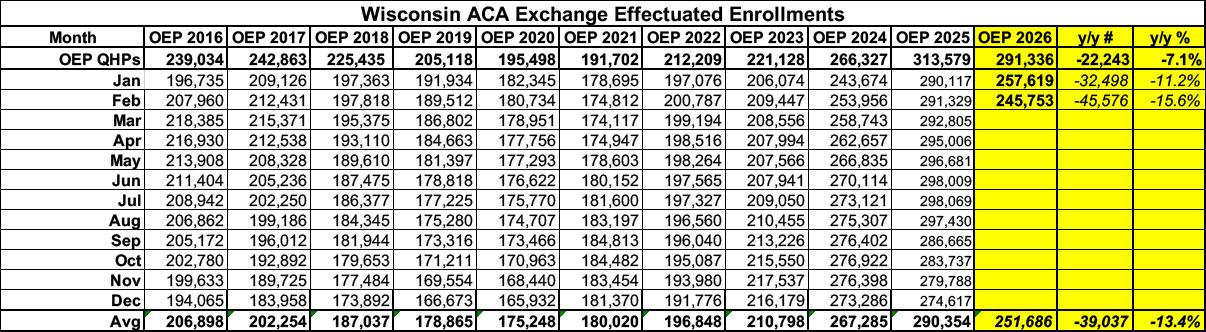
ACA exchange enrollment has dropped by over 15% in Wisconsin since Congressional Republicans allowed the enhanced federal subsidies to expire at the end of last year.
Initial signups during Open Enrollment were down 7% vs. OEP 2025...but effectuated enrollment was 11% lower year over year in January, rising to 15.6% lower as of February.
That's over 45,000 Wisconsinites who already lost coverage in just the first two months of the year...a number which has likely continued to climb since then.
Here's what this looks like visually, with both 2025 and 2019 (the last pre-COVID year, which didn't include the enhanced subsidies) included for comparison:
Medicare Advantage (technically "Medicare Part C" & originally called "Medicare+Choice") is a type of health plan in the United States offered by private companies as part of the original Social Security Act of 1965 that created Medicare. It permits a private insurance option that wraps around traditional Medicare. Medicare Advantage plans attempt to fill some coverage gaps and offer alternative coverage options.
Under Part C, Medicare pays a plan operator a fixed payment for each enrollee. The operator then pays for their medical expenses. Traditional Medicare directly compensates providers on a fee-for-service basis. Plans are offered by integrated health delivery systems, labor unions, non profit charities, and health insurance companies, which may limit enrollment to specific groups of people (such as union members).
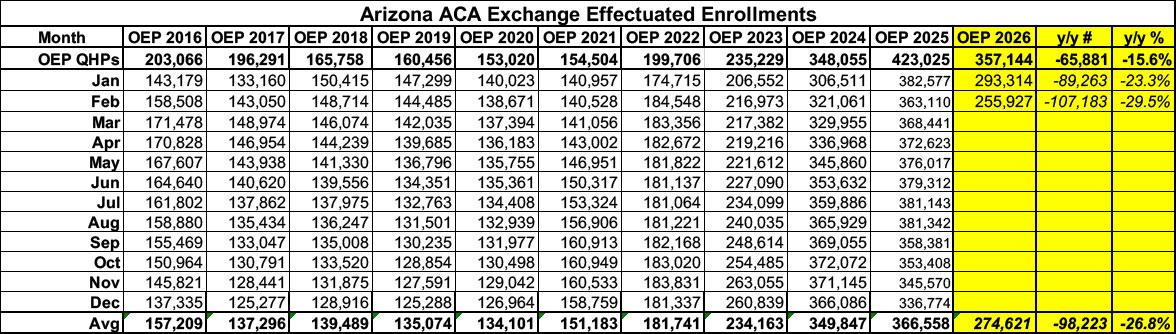
ACA exchange enrollment has dropped by nearly 30% in Arizona since Congressional Republicans allowed the enhanced federal subsidies to expire at the end of last year.
Initial signups during Open Enrollment were already down 15.6% vs. OEP 2025...and effectuated enrollment was 23% lower year over year in January, rising to nearly 30% by February.
That's over 107,000 Arizonans who already lost coverage in just the first two months of the year...a number which has likely continued to climb since then.
Here's what this looks like visually, with both 2025 and 2019 (the last pre-COVID year, which didn't include the enhanced subsidies) included for comparison:
Xiong Announces Express Lane Health Enrollment for Eligible Michigan Kids
“Express Lane Enrollment” legislation would enact a streamlined health care enrollment process for eligible children and young adults under 21
LANSING, Mich., April 23, 2026 — State Rep. Mai Xiong (D-Warren) recently introduced legislation that would enact a streamlined enrollment process for children and young adults under 21 who may be eligible for Medicaid and health care programs administered through the Michigan Department of Health and Human Services (MDHHS). Xiong’s House Bill 5884 provides a common sense fix: Express Lane Eligibility (ELE), already authorized under federal law, which allows DHHS to use existing Supplemental Nutrition Assistance Program (SNAP) and Temporary Assistance for Needy Families (TANF) data to streamline Medicaid enrollment for kids and young adults.
All of the enrollment data was based on official reports via the Centers for Medicare & Medicaid Services (CMS) through May 2026 for Medicare, Medicaid & CHIP and through February 2026 for ACA exchange coverage. I included estimated ACA enrollment data for March, April & May 2026 by extrapolating the limited hard data I did have for about a dozen or so states out nationally, including both a lower- and upper-bound range.
My conclusion at the time was that from January 2025 through May 2026...
Xiong, Cherry Introduce Medicaid Buy-In Program to Make Healthcare More Affordable for Michigan Workers
LANSING, Mich., Aug. 26, 2026 — State Rep. Mai Xiong (D-Warren) and state Sen. John Cherry (D-Flint) introduced legislation this week to create a Medicaid buy-in program to make affordable healthcare available for more Michiganders.House Bill 6274and its companion, Senate Bill 1152, would enable Michiganders earning between 138-200% of the federal poverty level to enroll in the program, giving working class families who don’t typically qualify for Medicaid assistance a more cost-effective alternative to other marketplace plans.
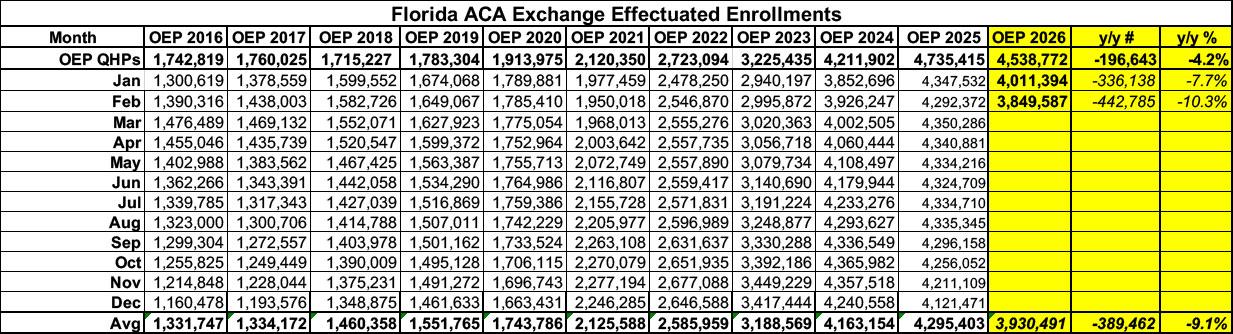
ACA exchange enrollment has dropped by more than 10% in Florida since Congressional Republicans allowed the enhanced federal subsidies to expire at the end of last year.
Initial signups during Open Enrollment were only down 4% vs. OEP 2025...but effectuated enrollment was 7.7% lower year over year in January, rising to 10.3% lower as of February.
That's over 440,000 Floridians who already lost healthcare coverage in just the first two months of the year...a number which has likely continued to climb since then.
...I could eliminate (or at least vastly narrow) the upper/lower bound estimates if CMS would actually update the actual Health Insurance Exchanges Monthly Effectuated Enrollment database, which is supposed to be updated monthly but which has been stuck at February 2026 for the past four months...