


How much more are ~128,000 NEBRASKA ACA enrollees *really* paying this year due to Trump/GOP policies?
Thu, 06/18/2026 - 1:58pm
IMPORTANT: See the original post in this series for an explanation of the methodology.
Regular readers know that I've been obsessing over the massive increases in both gross as well as net premiums for ACA health insurance policy enrollees being caused by the combination of Congressional Republicans allowing the enhanced federal tax credits to expire as well as other Trump Regime policy changes for well over a year and a half now.
I've written countless analyses of how much both gross and net premiums skyrocketed from 2025 to 2026 across different states, different income levels and various other demographics...and last week it was revealed that over 3 million ACA exchange enrollees had already been priced out of the market as of April, with the number almost certain to climb further throughout the rest of 2026.
As I've repeatedly warned, however, the increases in premium costs (whether gross or net) are only half the story. The other big shoe which is dropping this year is increased out of pocket costs as millions of the ~19.2 million or so remaining enrollees as of April have been forced to downgrade their coverage to avoid (or at least minimize) those massive premium spikes.
In most cases this means moving to plans with higher deductibles, higher co-pays & higher coinsurance costs. In many cases this has also included moving to plasn with worse networks, referral requirements to see specialists and so on.
With that in mind, that's exactly what I've decided to set out to do: Calculate the average year over year increase not just in net premiums (that is, how much more ACA enrollees are having to pay each month) but also the year over year change in average out of pocket costs.
Let's look at NEBRASKA:
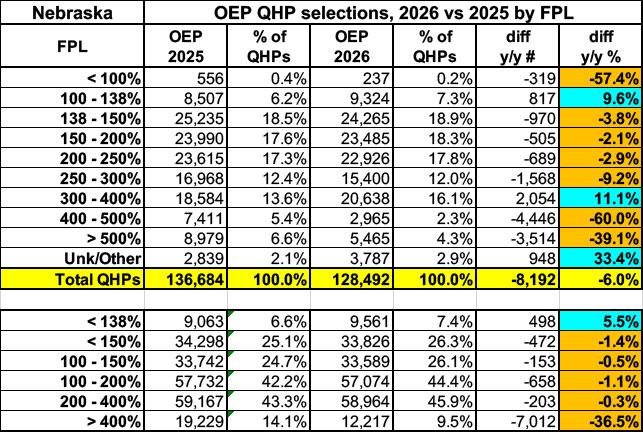
Here's a look at ACA exchange plan selections during Open Enrollment by household income level this year vs. last.
Enrollment at practically all income brackets has dropped, in some cases plummeting by as much as 60%. Enrollment below 100% of the Federal Poverty Level (FPL) has dropped by 57% (granted, it was only a few hundred to begin with), while it's dropped by ~36% over 400% FPL (enrollees over 400% FPL are no longer eligible for any federal financial help and have to pay full price).
Overall plan selections were already down more than 6% out of the gate, with over 8,000 Nebraskans losing coverage before it even kicked in:
Onto the main analysis:
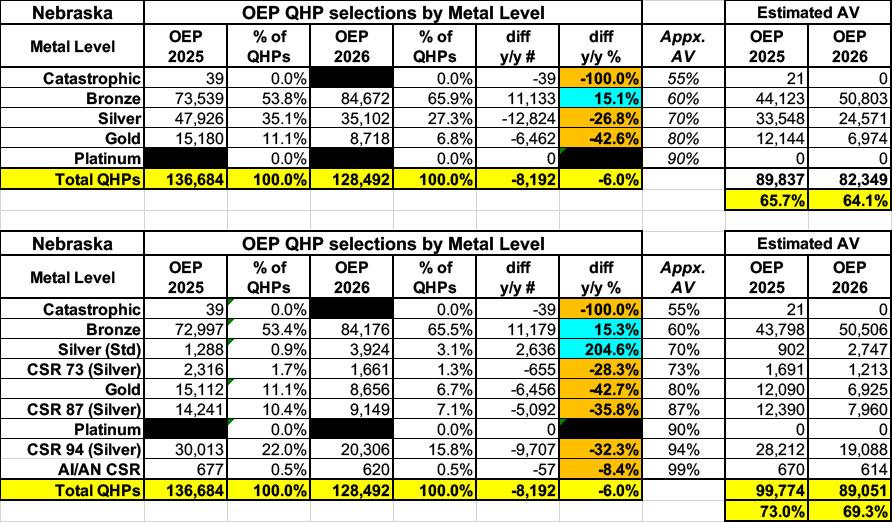
Here's total Open Enrollment plan selections for both 2025 & 2026 broken out by Actuarial Value (AV) category. The first table is based on official metal level tiers, but it's the second table which is critical, since a huge chunk of ACA enrollees are usually enrolled in CSR Silver plans (which include Cost Sharing Reduction assistance). CSR assistance dramatically boosts the AV of Silver plans up to Platinum levels in most cases.
As a result, the overall Actuarial Value of Nebraska enrollees dropped from 73% to 66.3% as the enrollees who weren't priced out of coverage entirely downgraded to worse plans: Enrollment in "Platinum-equivalent" high-CSR Silver plans dropped by more than 30% while Gold enrollment dropped by over 40%.
The only tiers which saw an increase were Bronze plans (up around 15%) an standard Silver, which tripled. Catastrophic plan enrollment dropped to nothing, but that's because no carriers are even bothering to offer them this year anyway:
By combining these numbers with the average gross premiums per enrollee I'm able to calculate an estimate of the average total medical expenses each enrollee racks up each year assuming an 80% average Medical Loss Ratio (as I stated in the original post, this can vary widely by carrier and year, so should be considered a very broad average only), which looks like so:
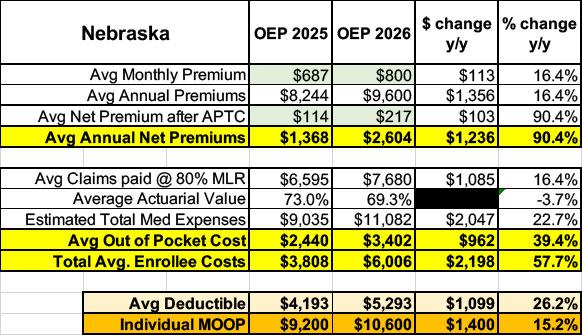
Even with the scramble to "buy down" to cheaper, crappier coverage, average net premiums for the ~128,000 who signed up during Open Enrollment still shot up by 90% on average, from $114/mo to $217/mo. That's over $1,200 more in premiums per enrollee per year.
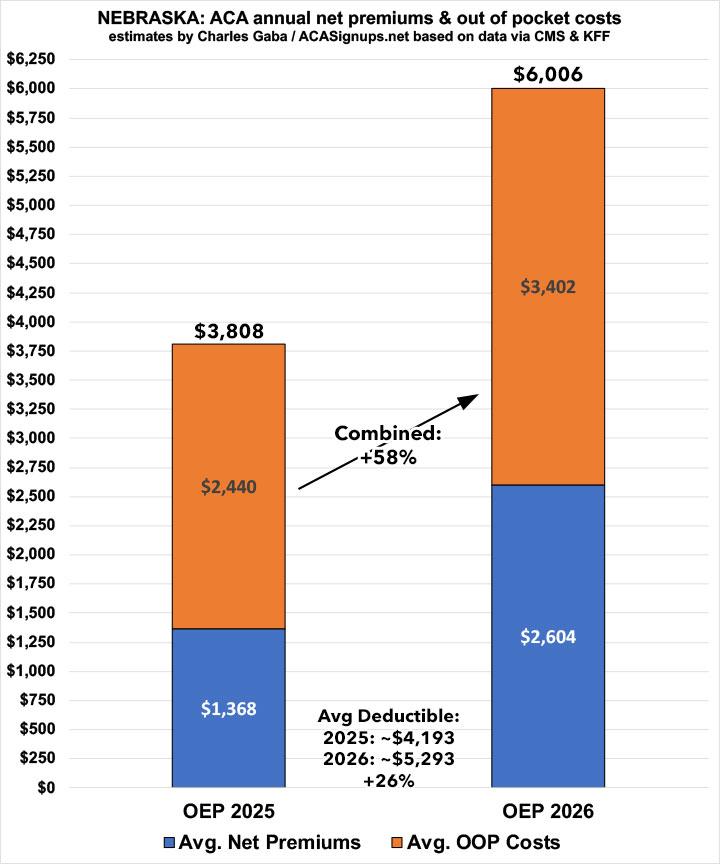
Adding insult to injury: Downgrading to worse coverage has also resulted in out of pocket expenses jumping by an estimated ~39%, for a combined average healthcare cost increase of ~58%.
That's a total increase from ~$3,800 to over $6,000 per enrollee this year...or ~$2,200 more apiece.
In addition, based on KFF's net data, average deductibles also increased by ~26% to ~$5,300 for single coverage this year, and the maximum (theoretical) out of pocket cut-off for all ACA enrollees went up by over 15% this years as well, to $10,600 for single coverage.
Next up: NEVADA.
Advertisement


