


Final 2026 Open Enrollment Report: Household Income (<138% FPL)
Wed, 04/08/2026 - 4:03pm
Next, we come to HOUSEHOLD INCOME BRACKETS.
This is, of course, extremely important since household income is one of the most critical factors in calculating how much financial assistance enrollees receive (or if they're eligible for Advance Premium Tax Credits (ATPC) at all).
Since there's so many income bracket columns and there's a lot to delve into for many of them, I've broken the full spreadsheet out into several sections/posts. The first focuses on exchange enrollees who earn less than 138% of the Federal Poverty Level (FPL). This is a critical threshold because it's the cut-off point for ACA Medicaid expansion eligibility in the 40 states (+DC) which have expanded the program.
There's actually two distinct populations here: Enrollees who earn less than 100% FPL and those who earn between 100 - 138% FPL.
ACA enrollees earning under 100% FPL make up a pretty small portion of total ACA exchange enrollment for several reasons. The first, of course, is because most states have expanded Medicaid out to the 138% FPL threshold; the second is that even in non-expansion states, federal tax credits are generally only available to enrollees who earn more than 100% FPL.
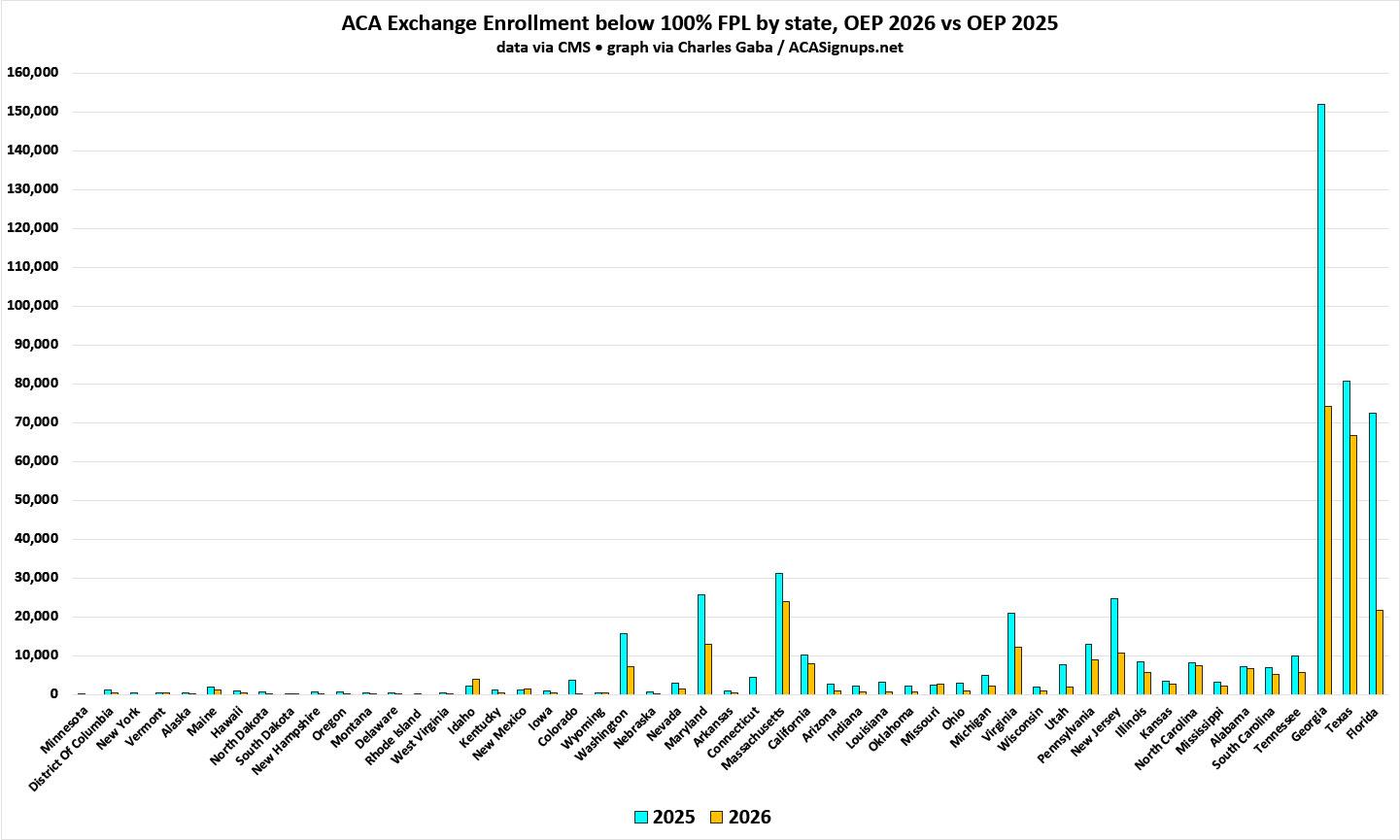
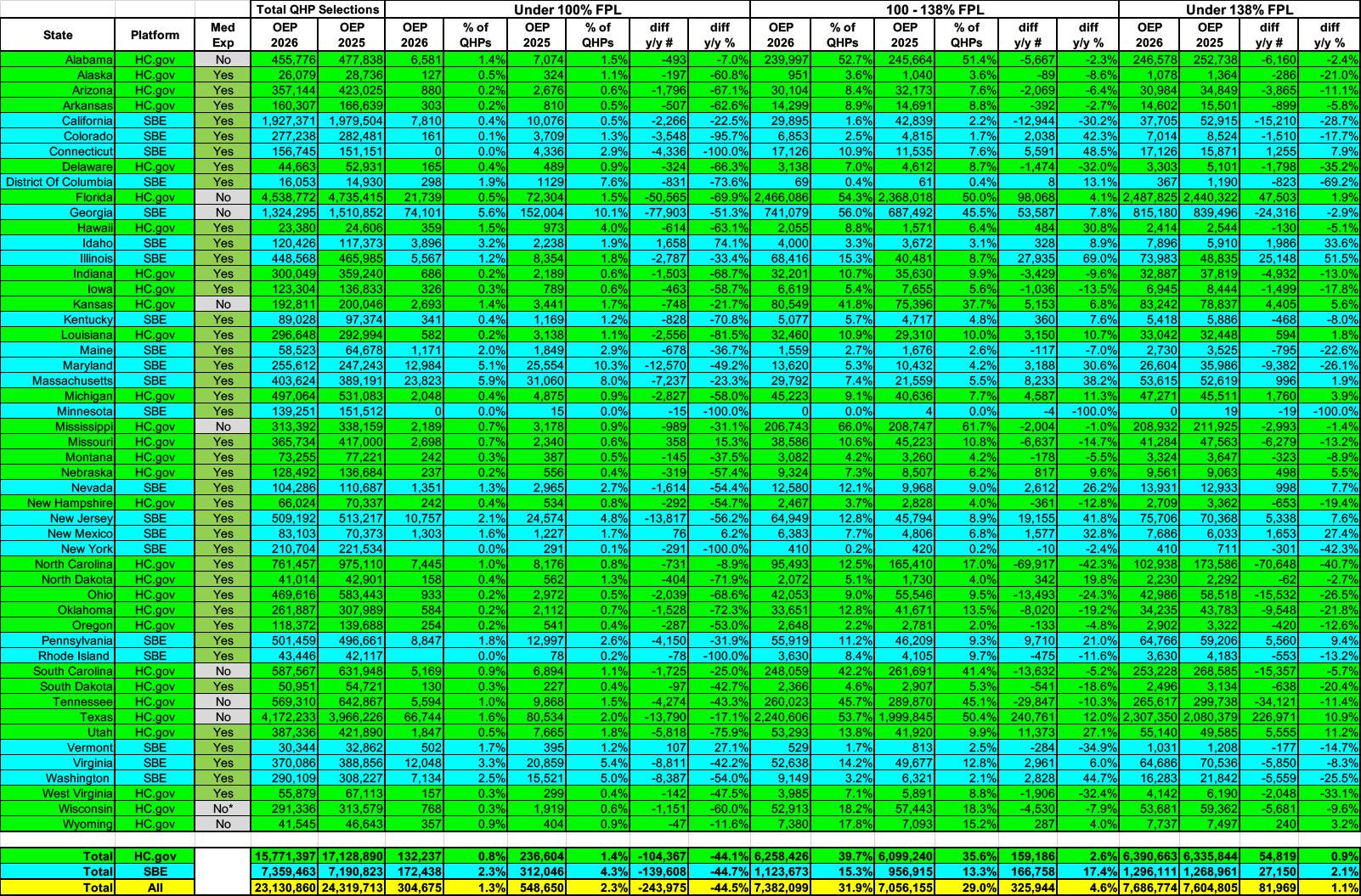
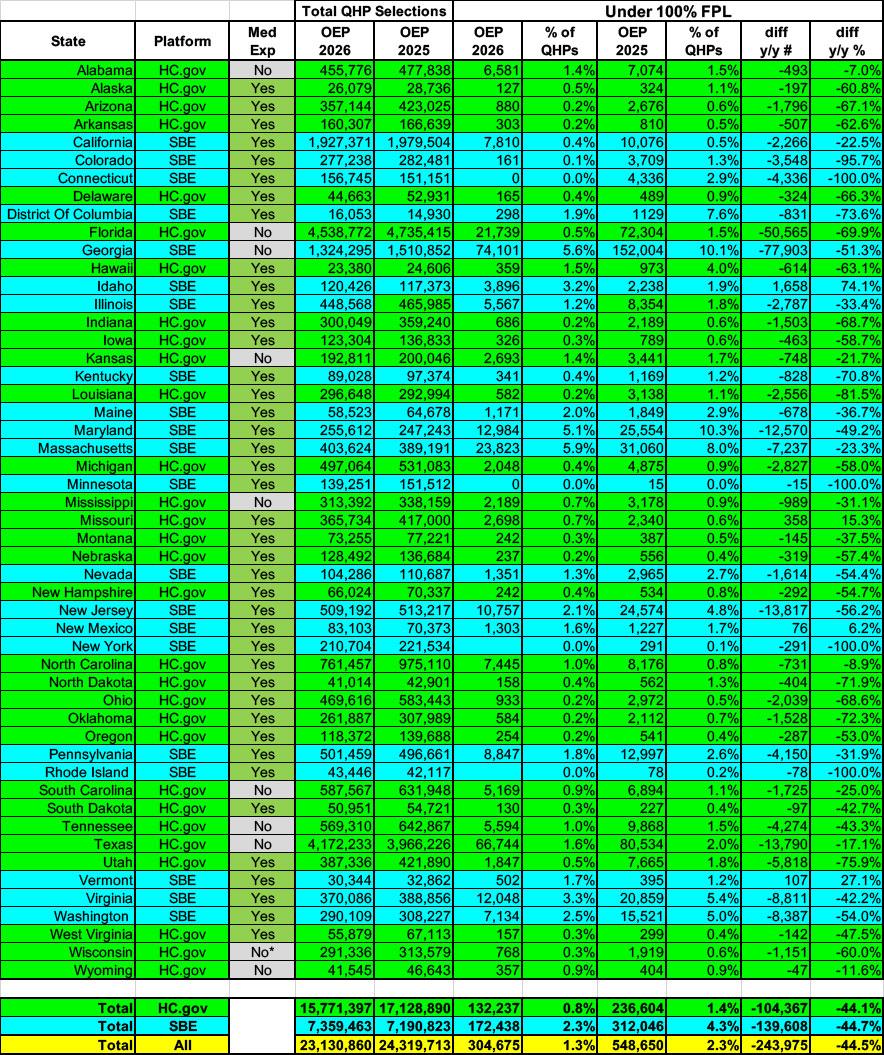
HOWEVER, there are a couple of exceptions...mainly for lawfully present immigrants (ie, documented) who aren't eligible for Medicaid due to their immigration status...which basically means that they've been living in the United States for less than 5 years. Last year around 550,000 people fell into this category nationally, or roughly 2.3% of all exchange enrollees. Over 150,000 were in Georgia, followed by Texas and Florida.
Unfortunately, these exceptions have been dramatically weakened via both Trump Regime policy changes as well as last year's Big Ugly Bill (H.R. 1, officially the "One Big Beautiful Bill Act"). Specifically, under both the Big Ugly Bill and the 2027 NBPP rule, that exception is now gone.
Let me repeat that: These are people who chose to move to the United States to pursue the American Dream, did everything the right way, followed all of the paperwork & filing protocols they were supposed to...but because they've lived here for less than 5 years, they're neither eligible for Medicaid nor can they receive any financial assistance with private insurance.
As a result, exchange enrollment below the 100% FPL threshold plummeted by a whopping 45% this year, from ~549,000 to just 305,000 individuals. This includes nearly 78,000 losing coverage in Georgia alone and over 50,000 in Florida.
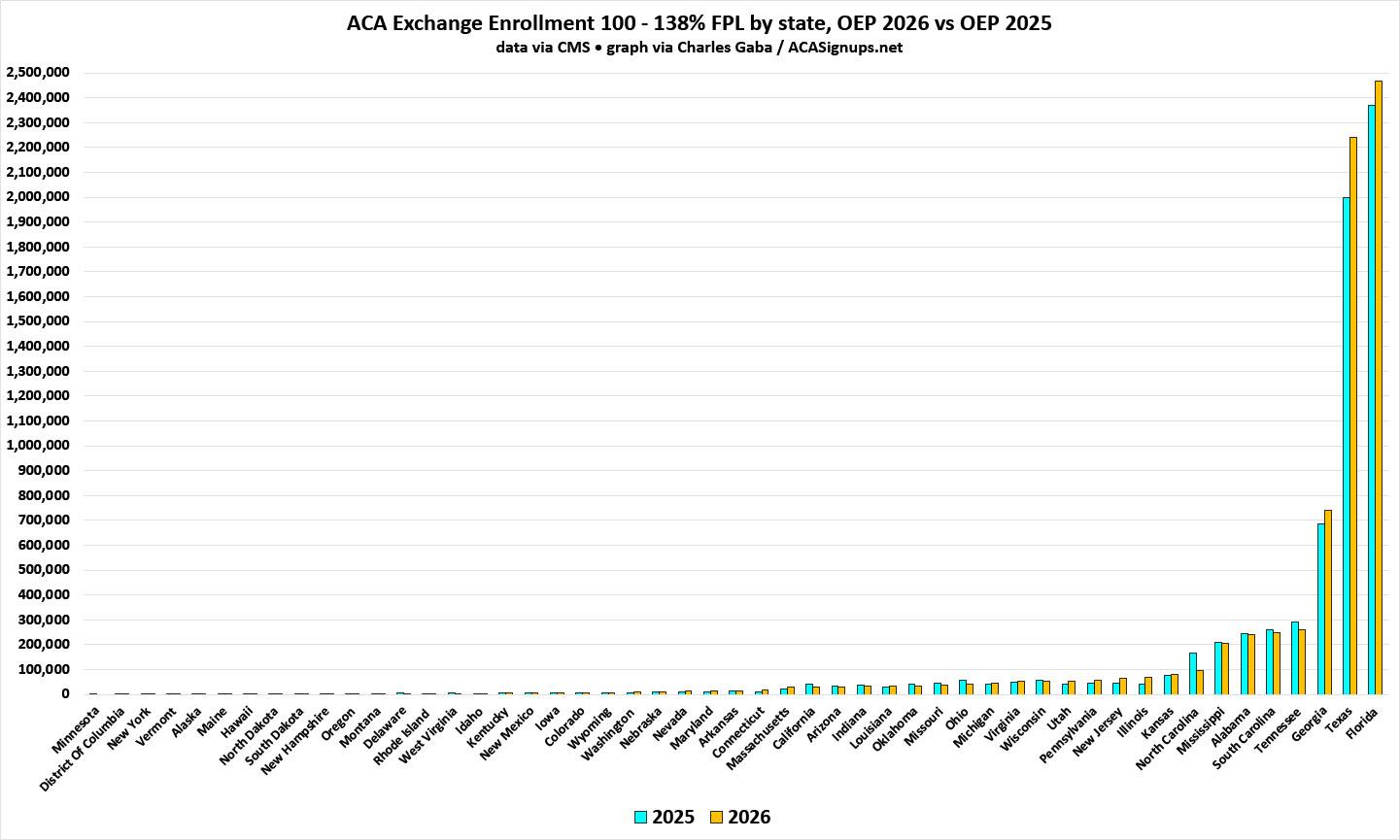
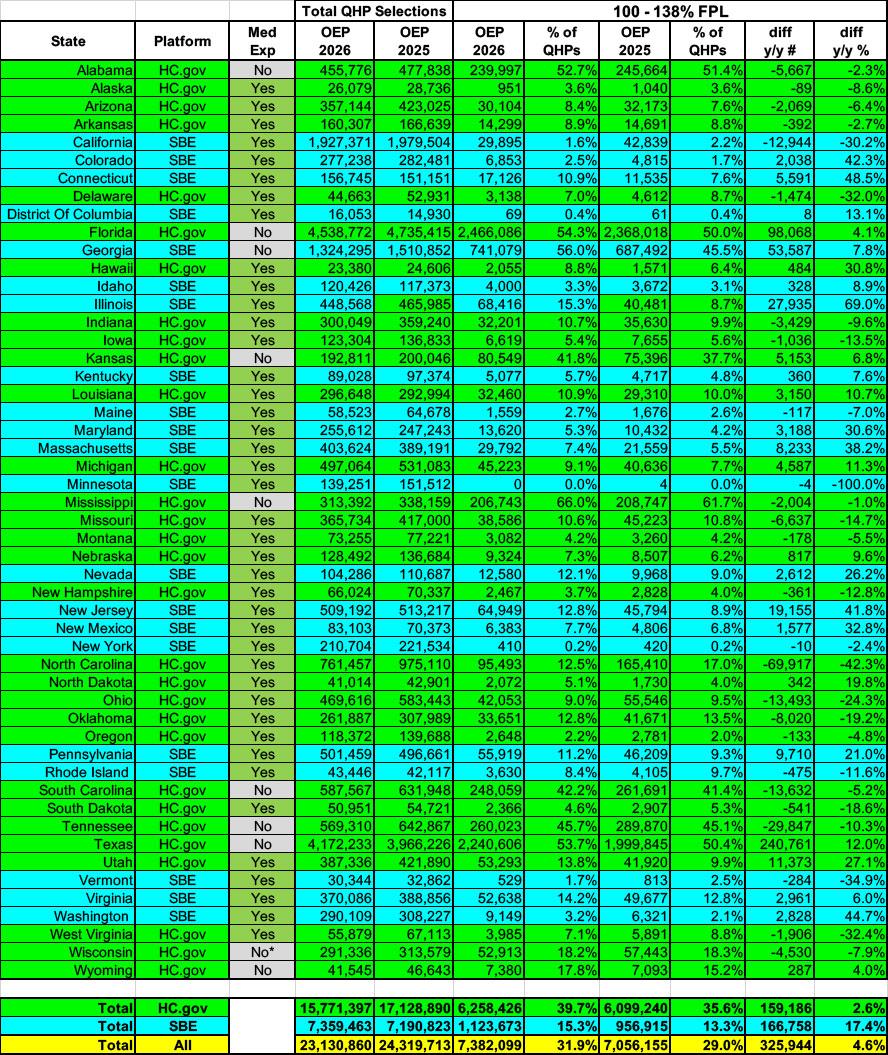
As for the 100 - 138% FPL population, a stunning 32% of all ACA exchange enrollees fall into this income bracket. This may sound surprising given that, again, Medicaid expansion provides coverage for residents who earn up to 138% FPL...until you remember that 10 states, including two of the largest, are still refusing to expand Medicaid under the ACA.
In the ten non-expansion states, uninsured residents who earn more than 100% FPL but less than 138% FPL are indeed eligible for ACA tax credits (even if those are far less generous than they were last year). In Texas and Florida alone, over 4.7 million enrollees fall into this category (2.5 & 2.2 million respectively), and nationally it's nearly 7.4 million, with nearly 90% being found in the non-expansion states.
I should note that if the 10 holdout states were to ever actually expand Medicaid properly, the vast majority of those ~7.4 million people would shift over to Medicaid coverage while ACA exchange enrollment would drop by a similar amount...reducing it by around 30% or so.
It's also worth noting that while enrollment under 100% FPL has fallen off a cliff, enrollment in the 100 - 138% FPL bracket actually increased by about 4.6%, or by over 325,000 people. I found this to be a bit surprising...it actually did drop in about half the states, but this was canceled out by increases in the other half, and two states alone account for more than 100% of the 100 - 138 growth: Texas and Florida. Huh.
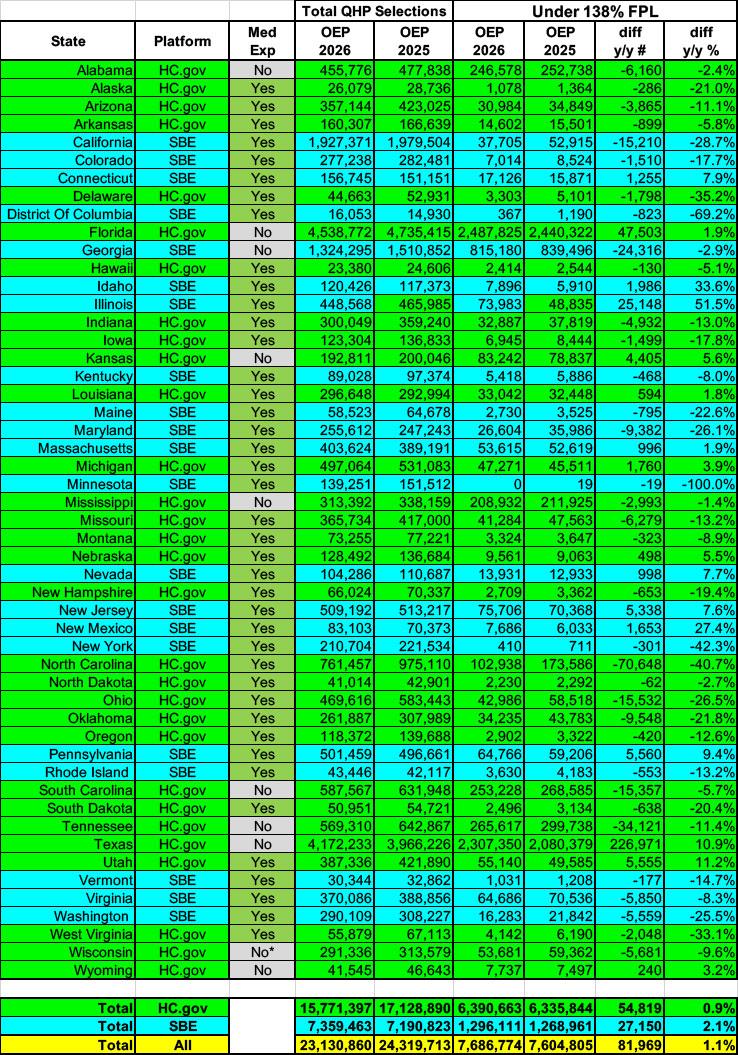
In any event, the net result of this is that combined, enrollment below 138% FPL actually increased slightly year over year, by about 82,000 people or 1.1% nationally.
Tomorrow I'll tackle enrollment at the at the 100 - 150% & 150 - 200% FPL brackets (and possibly 200 - 400%, though those may have to wait until Friday).
Advertisement


